Breaking the Mold at ACC.26: HeartLung.AI Emerges as the Only Exhibitor With Seven Scientific Presentations
NEW ORLEANS , LA, UNITED STATES, March 19, 2026 /EINPresswire.com/ -- HeartLung.AI today announced that it will showcase seven scientific presentations at ACC.26, the American College of Cardiology’s 75th Annual Scientific Session & Expo, taking place next weekend in New Orleans. HeartLung is the only company in the entire cardiovascular industry exhibit hall that has seven accepted scientific presentations at ACC Scientific Sessions. HeartLung will exhibit at Booth 109 and will present new data spanning atrial fibrillation, heart failure, stroke risk, AI-based coronary calcium scoring, plaque hyperdensity, and opportunistic analysis of routine gated and non-gated CT scans.
“These accepted ACC presentations reinforce our core belief that routine CT scans contain far more actionable cardiovascular information than is being used today,” said Morteza Naghavi, M.D., founder of HeartLung. “Our goal is to help clinicians unlock that information from scans they already have, enabling earlier, more scalable, and more cost-effective prevention of heart disease, heart failure, atrial fibrillation, and stroke.”
The seven HeartLung presentations span multiple areas of cardiovascular prevention and opportunistic imaging:
• AI-CVD-AF describes a novel atrial fibrillation prediction model built solely from coronary artery calcium scans and reported stronger performance than CHARGE-AF, suggesting that CAC imaging may support earlier AF risk detection without additional lab or clinical inputs.
• AI-CVD-HF presents a heart failure prediction model derived from CAC scans that outperformed PREVENT-HF, supporting the idea that existing CT imaging can be used to expand heart failure risk assessment beyond traditional coronary disease evaluation.
• AI-derived chamber analysis found that left atrial volume index and chamber volume ratios from CAC scans predicted long-term atrial fibrillation and stroke and added value beyond established clinical risk scores.
• AI-enabled CAC hyperdensity index introduces a new way to characterize plaque biology from CAC scans, with findings suggesting the metric may improve risk assessment and help distinguish plaque progression from stabilization.
• AI-CAC 'Power of Zero' study showed that AI-based calcium scoring may refine the traditional Agatston zero concept by identifying additional risk information in patients previously classified as zero.
• AI-based atrial volumetry from non-gated lung CT scans provided atrial fibrillation and stroke prediction comparable to gated cardiac CT, expanding the potential utility of routine chest CT stored in PACS.
• AI-based ventricular volumetry from non-gated lung CT scans provided heart failure prediction comparable to gated cardiac CT, supporting broader opportunistic use of routine thoracic imaging.
Together, these studies support HeartLung’s broader AI-CVD vision: transforming routine CT scans into a scalable platform for earlier cardiovascular detection, better risk stratification, and more personalized prevention across multiple disease states.
Attendees at ACC.26 are invited to visit HeartLung at Booth 109 to learn how the company’s AI-CVD, AI-CAC, AutoChamber, and related technologies are designed to help health systems extract more clinical value from scans already acquired in routine care.
About HeartLung Technologies
HeartLung Technologies is a pioneer in AI-driven preventive imaging, focused on early detection of cardiovascular disease, lung cancer, COPD, osteoporosis, fatty liver disease, and other conditions detectable on CT scans. Its flagship platform, AI-CVD, transforms routine CT imaging into a scalable platform for comprehensive cardiovascular risk assessment and prevention.
About AI-CVD
AI-CVD is an FDA-cleared, AI-powered platform that performs fully automated analysis of CT scans to detect and quantify cardiovascular disease. By enabling opportunistic screening across large populations, AI-CVD supports earlier intervention, improved outcomes, and reduced healthcare costs. AI-CVD is uniquely designed to align clinical impact with economic value. By converting routine CT scans into scalable screening opportunities, AI-CVD enables health systems to improve patient care, increase patient engagement, and generate new downstream revenue from preventive cardiology, imaging, and therapeutic interventions, while reducing the burden of advanced (late-stage) cardiovascular disease.
AI-CVD Components
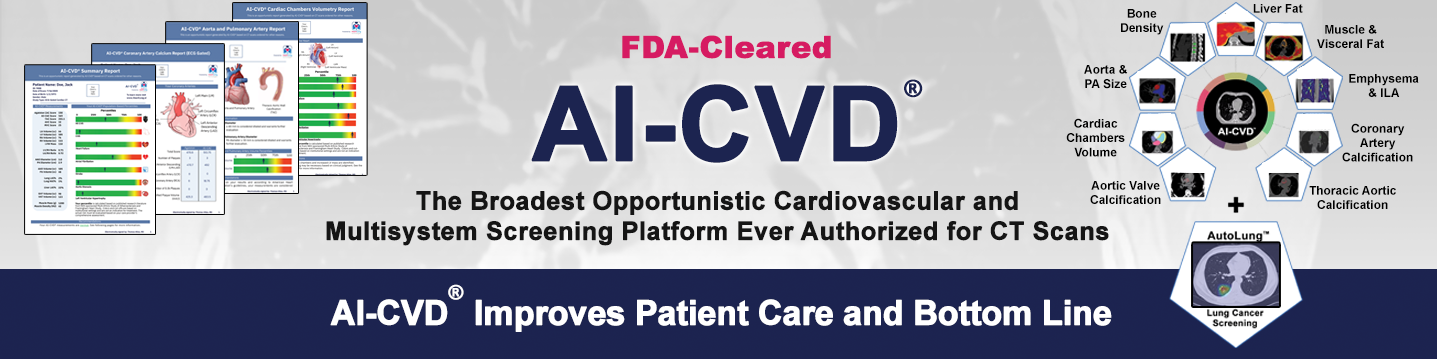
AI-CVD delivers a comprehensive, automated assessment from a single scan, including:
• Coronary artery calcium (AI-CAC®) for atherosclerotic CVD
• Aortic and valvular calcification (TAC/AVC) for valvular disease and stroke
• Cardiac chamber volumetry (AutoChamber®) for heart failure and AF
• Aorta and pulmonary artery sizing for aortic aneurysm and pulmonary hypertension
• Epicardial and visceral fat for cardiometabolic disease
• Liver density for hepatic steatosis leading to CVD
• Lung density (emphysema/COPD/ILA linked to CVD and lung cancer)
• Bone mineral density (bone fracture risk)
AI-CVD Impact
AI-CVD converts routine CT imaging into a scalable prevention platform enabling earlier detection of silent disease, improved outcomes, and new pathways for preventive cardiology. Enterprise projections show that AI-CVD adoption can lead to meaningful reductions in major adverse cardiovascular events (MACE), improved population health outcomes, and substantial financial return over a five-year period through integrated care pathways and earlier intervention.
“These accepted ACC presentations reinforce our core belief that routine CT scans contain far more actionable cardiovascular information than is being used today,” said Morteza Naghavi, M.D., founder of HeartLung. “Our goal is to help clinicians unlock that information from scans they already have, enabling earlier, more scalable, and more cost-effective prevention of heart disease, heart failure, atrial fibrillation, and stroke.”
The seven HeartLung presentations span multiple areas of cardiovascular prevention and opportunistic imaging:
• AI-CVD-AF describes a novel atrial fibrillation prediction model built solely from coronary artery calcium scans and reported stronger performance than CHARGE-AF, suggesting that CAC imaging may support earlier AF risk detection without additional lab or clinical inputs.
• AI-CVD-HF presents a heart failure prediction model derived from CAC scans that outperformed PREVENT-HF, supporting the idea that existing CT imaging can be used to expand heart failure risk assessment beyond traditional coronary disease evaluation.
• AI-derived chamber analysis found that left atrial volume index and chamber volume ratios from CAC scans predicted long-term atrial fibrillation and stroke and added value beyond established clinical risk scores.
• AI-enabled CAC hyperdensity index introduces a new way to characterize plaque biology from CAC scans, with findings suggesting the metric may improve risk assessment and help distinguish plaque progression from stabilization.
• AI-CAC 'Power of Zero' study showed that AI-based calcium scoring may refine the traditional Agatston zero concept by identifying additional risk information in patients previously classified as zero.
• AI-based atrial volumetry from non-gated lung CT scans provided atrial fibrillation and stroke prediction comparable to gated cardiac CT, expanding the potential utility of routine chest CT stored in PACS.
• AI-based ventricular volumetry from non-gated lung CT scans provided heart failure prediction comparable to gated cardiac CT, supporting broader opportunistic use of routine thoracic imaging.
Together, these studies support HeartLung’s broader AI-CVD vision: transforming routine CT scans into a scalable platform for earlier cardiovascular detection, better risk stratification, and more personalized prevention across multiple disease states.
Attendees at ACC.26 are invited to visit HeartLung at Booth 109 to learn how the company’s AI-CVD, AI-CAC, AutoChamber, and related technologies are designed to help health systems extract more clinical value from scans already acquired in routine care.
About HeartLung Technologies
HeartLung Technologies is a pioneer in AI-driven preventive imaging, focused on early detection of cardiovascular disease, lung cancer, COPD, osteoporosis, fatty liver disease, and other conditions detectable on CT scans. Its flagship platform, AI-CVD, transforms routine CT imaging into a scalable platform for comprehensive cardiovascular risk assessment and prevention.
About AI-CVD
AI-CVD is an FDA-cleared, AI-powered platform that performs fully automated analysis of CT scans to detect and quantify cardiovascular disease. By enabling opportunistic screening across large populations, AI-CVD supports earlier intervention, improved outcomes, and reduced healthcare costs. AI-CVD is uniquely designed to align clinical impact with economic value. By converting routine CT scans into scalable screening opportunities, AI-CVD enables health systems to improve patient care, increase patient engagement, and generate new downstream revenue from preventive cardiology, imaging, and therapeutic interventions, while reducing the burden of advanced (late-stage) cardiovascular disease.
AI-CVD Components
AI-CVD delivers a comprehensive, automated assessment from a single scan, including:
• Coronary artery calcium (AI-CAC®) for atherosclerotic CVD
• Aortic and valvular calcification (TAC/AVC) for valvular disease and stroke
• Cardiac chamber volumetry (AutoChamber®) for heart failure and AF
• Aorta and pulmonary artery sizing for aortic aneurysm and pulmonary hypertension
• Epicardial and visceral fat for cardiometabolic disease
• Liver density for hepatic steatosis leading to CVD
• Lung density (emphysema/COPD/ILA linked to CVD and lung cancer)
• Bone mineral density (bone fracture risk)
AI-CVD Impact
AI-CVD converts routine CT imaging into a scalable prevention platform enabling earlier detection of silent disease, improved outcomes, and new pathways for preventive cardiology. Enterprise projections show that AI-CVD adoption can lead to meaningful reductions in major adverse cardiovascular events (MACE), improved population health outcomes, and substantial financial return over a five-year period through integrated care pathways and earlier intervention.
Marlon Montes
HeartLung Technologies
+1 310-510-6004
email us here
Visit us on social media:
LinkedIn
X
Legal Disclaimer:
EIN Presswire provides this news content "as is" without warranty of any kind. We do not accept any responsibility or liability for the accuracy, content, images, videos, licenses, completeness, legality, or reliability of the information contained in this article. If you have any complaints or copyright issues related to this article, kindly contact the author above.